Excerpts from ‘THE STORY OF A SHIP’S LIFEBOAT CALLED’ SANDA by Moira Forrester (Daughter of Alex and Mary Marshall)
One day, when I was almost five years old, my Dad came
home and told my Mum that he had bought a boat. This
was astonishing as we didn’t live by the sea. We lived
in a top floor room and kitchen flat in a typical Glasgow
tenement in Springburn, a district famous for building
steam locomotives, railway carriages and wagons and miles
from the sea. I don’t know what my Mum thought about
this, but after she recovered from the surprise, we all went
to see the boat. It was moored at a place called Inchinnan
Cruising Club on the River Clyde. Dad pointed out our boat.
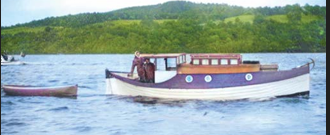
It was an old ship’s lifeboat that had a cabin built on it and
was painted white with a brown cabin. He said its name
was SANDA, called after a small island on the west coast of
Scotland, and that was the first time I saw SANDA, which
was to become a big part of my childhood and my life. Dad
didn’t want to sail his boat on the Clyde, he wanted to sail
it on Loch Lomond.
It was an epic journey sailing the Sanda down the Clyde and
into the river Leven. A couple of men from Inchinnan Cruising
Club told Dad it was ideal conditions and they knew how to
get the boat up the river. It was spring and the Leven was in
spate with the snow melting on the mountains and there had
been plenty of rain. Unfortunately, the engine could hardly
push the boat as the force of the water was so strong. The
river twists and turns and trying to negotiate round bends was
almost impossible as the surging water pushed the boat into
the bank of the river. They struggled for hours but lost control
and broke a wooden rudder. A second rudder was broken but
this time a hole was punched in the hull. They were stuffing bits
of tarpaulin into the hole and pumping out the boat. Dad and
the two men were wet and tired but had to go on and another
rudder made of steel was offered and the battle continued. it
was very late when the Sanda limped into Balloch and into the
Fisherwood Boat Yard.
After the boat was repaired Dad moored the boat in the
River Leven beside Balloch Park. My parents intended to
spend the Fair Fortnight on the boat and as it was 1947 a
lot of the equipment was purchased from the army and navy
surplus store. Dad bought four kapok filled mattresses, four
army blankets and four pillows. Mum made covers for the
mattresses and pillows on her Singer treadle sewing machine.
Transporting the mattresses to the boat was the next problem
but there was no stopping Dad. He made two huge parcels
each with two folded mattresses covered with tarpaulin and
tied very securely with rope and labels attached. On one side
was his name and address and on the other he wrote, TO BE
COLLECTED AT BALLOCH. He carried one huge parcel on
his shoulder down three flights of stairs and all the way to
Springburn Railway Station and bought a ticket for it and came
back home for the second parcel. He went to Balloch the next
day and collected them at Balloch Railway Station and carried
them all the way to dinghy and finally onto the boat. Dad did
this every year as it was too cold and damp to leave bedding
on the boat all winter.
There was no sink, toilet, electricity or cooker on the boat.
Cooking was done on a brass Primus stove and a modified old
blow lamp on the floor. It was basic.
Dad bought an Admiralty Chart of Loch Lomond that was first
printed in 1861 and found a bay that was sheltered to spend the
night and we were on our way. It was a lovely day and it was
amazing to feel the boat moving and chugging up the river and
out into the Loch. It was a stunning sight, the huge expanse
of water with little waves glittering in the sun and the green
gentle hills all around with the big mountains up ahead. It was
spring and the leaves and blossom were coming out on the
trees and the air was so fresh and clean. Coming from a city
the size of Glasgow with sandstone tenement buildings lining
the cobbled streets and lots of tramcars, buses, vans and lorries
not to mention horses and carts, it was such a contrast, and the
impact of it has remained with me all of my life.
The weekend was a huge success, we got to know the boating
community who always came at weekends. People of all ages
were there from young children like us and teenage boys,
young adults and men and women of all ages and there was
a lot of fun with a huge bonfire in the evening where we sang
and told stories some very funny and some dramatic. My sister
and I played on the beautiful silver sand beach on Inchmoan,
and we enjoyed ourselves so much that we wanted to be there
every weekend and that is exactly what we did. From then
until I was 19 years old, we went every weekend from April to
the last weekend in September. We explored the length and
breadth of the Loch occasionally sailing up the river Falloch and
climbing Ben Lomond and picking brambles at the Fruin (my
Mum made 40lbs of fabulous jelly every year (and I continued
the tradition) and the boat community supported each other
all the way. My sister and I eventually went on holiday with our
friends and got married and both of us had a boat on the Loch.
The community was still there only older and with their children
and grandchildren.
My parents gave my sister and me a unique and wonderful
childhood sailing on the SANDA and I will be eternally grateful
to them for their ingenuity and resilience. They overcame many
problems with good humour and little resources and I wrote the
book in their memory.
The book is suitable for children aged 7 to 13 years but could
be read by anyone as it’s the true story of a girl who was brought
up in Glasgow tenements in the 1940s and 50s, and whose life
was completely changed when her father bought a boat.
You can buy copies of the book that this article is an excerpt
from in Amazon.
Just key in Children’s Books, author Moira Forrester and
two books should appear, the first one I wrote called The
story of a black cat called Cheech and The story of a ship’s
lifeboat called SANDA.
